Commercial Flat Roofs in Fort Lauderdale: Tackling Ponding Water & Thermal Expansion
———————————————————————————— Nast Roofing Co. ————————————————————————————
Managing a commercial property in Fort Lauderdale comes with a unique set of structural demands. Between torrential tropical downpours, high humidity, and intense year-round sunshine, low-slope and flat commercial roofs take a relentless beating.
If you oversee a retail strip, warehouse, office building, or multi-family complex, two major environmental forces are constantly working against your roof field: ponding water and thermal expansion.
Left unaddressed, these two challenges can cause premature membrane degradation, severe structural stress, and costly tenant disruption. At Nast Roofing, a licensed and insured commercial roofing company, we’ve spent over 30 years helping South Florida property managers protect their commercial investments. In this guide, we break down why these issues occur, the long-term damage they cause, and the proactive drainage and restoration solutions that keep your building leak-free.
The Dangers of Ponding Water on Low-Slope Roofs
While "flat roof" is a common term, no roof should ever be completely flat. Every commercial system requires a slight pitch to direct rainfall toward internal drains, scuppers, or gutters.
According to the
National Roofing Contractors Association (NRCA),
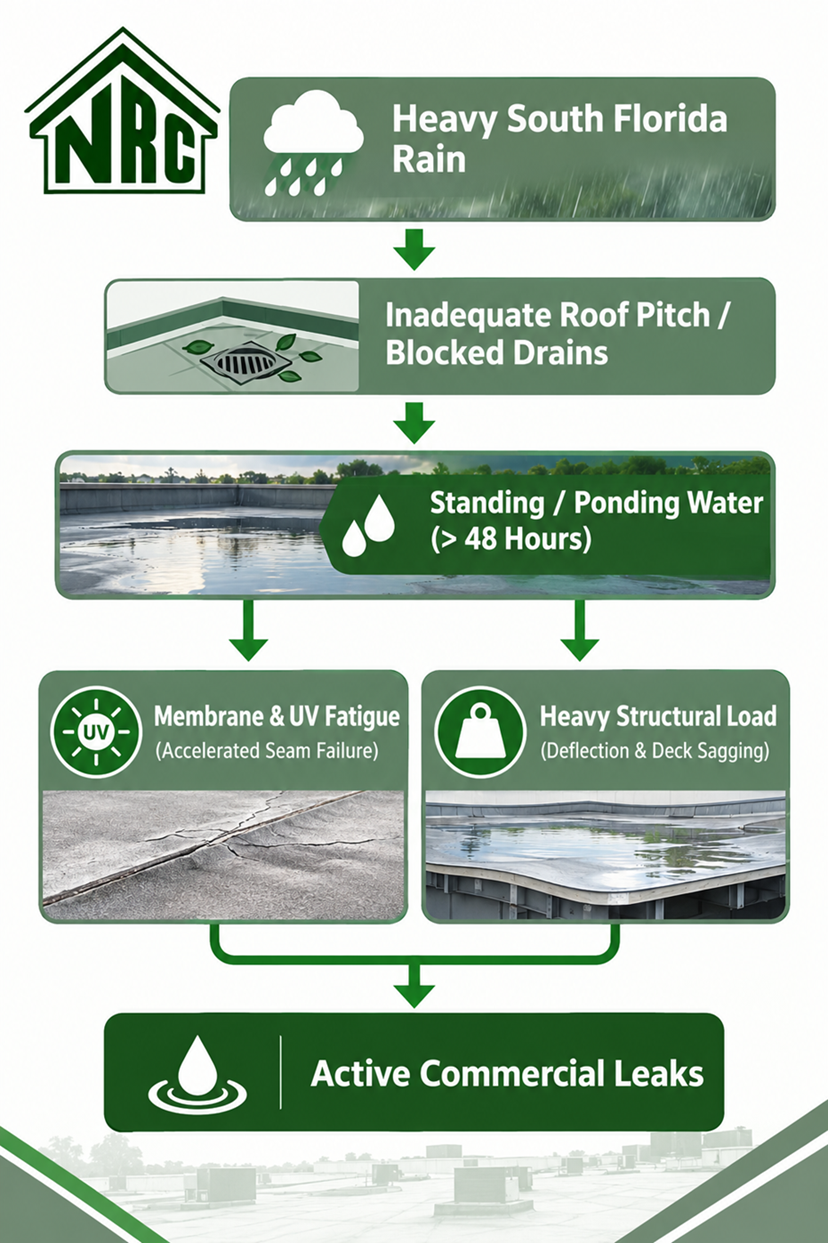
ponding water is defined as water that remains on a roof surface 48 hours or more after precipitation stops. In South Florida's climate, allowing standing water to sit on your building triggers a fast chain reaction of structural issues.
Why Standing Water Destroys Flat Membranes
- Magnified UV Beam Aging: Standing water acts like a magnifying glass under the intense Fort Lauderdale sun. The pool focuses solar radiation along the water line, rapidly breaking down single-ply TPO, PVC, or modified bitumen membranes.
- Massive Structural Dead Load: Water weighs approximately 5.2 pounds per square foot per inch of depth. A 500-square-foot ponding area filled with just two inches of standing water adds over 5,000 pounds of unplanned weight to your roof deck. This weight causes the roof structure to deflect (sag) further, creating a bigger bowl that holds even more water.
- Seam Submersion & Adhesive Breakdown: Membrane lap seams are engineered to shed water, not remain continuously submerged. Prolonged submersion softens adhesives and heat welds, giving wind-driven rain a direct path into your insulation board.
Thermal Expansion & Contraction: The "Thermal Shock" Cycle
South Florida commercial roofs endure extreme surface temperature swings every single day. A dark modified bitumen or aging flat roof can easily reach 150°F to 180°F during an August afternoon. When a sudden afternoon thunderstorm dumps 75°F rain across that baking surface, the temperature drops dramatically within minutes.
This rapid cooling causes thermal shock.
How Thermal Movement Damages Commercial Buildings
- Membrane Fatigue & Splitting: As the roof membrane continuously expands under heat and contracts under rain, the material loses its elasticity over time. This leads to hairline cracks, seam pulling, and splitting at wall flashings.
- Fastener Back-Out: The daily expansion and contraction cycle causes mechanical fasteners beneath the insulation or membrane to gradually work themselves loose. Backed-out screws can puncture single-ply membranes from underneath.
- Parapet Wall Cracking: Thermal movement doesn't just affect the flexible membrane; it exerts force against rigid structural perimeters, causing masonry parapet walls, metal coping caps, and wall terminations to crack and leak.
Request Your FREE Roofing Estimate!
Proactive Drainage & Restoration Solutions
Fixing ponding water and thermal stress doesn't always require a multi-million-dollar, full tear-off replacement. Property managers have access to modern engineering methods and fluid-applied systems that restore positive drainage and reflect heat.
A. Installing Tapered Insulation Crickets
If low spots are caused by localized roof deck settling or improper original slope, installing tapered polyisocyanurate insulation crickets creates a custom slope toward your primary drains or perimeter scuppers. This eliminates standing water pockets and satisfies the Florida Building Code's minimum slope requirements.
B. Upgrading Drainage & Overflow Scuppers
Blocked or undersized internal drains are the leading cause of sudden ponding. Adding secondary (emergency) overflow scuppers through parapet walls ensures that if a primary drain gets clogged with storm debris, water still exits the roof before reaching dangerous weight loads.
C. Fluid-Applied Cool Roof Coatings (Silicone & Elastomeric)
To combat thermal expansion, property managers frequently turn to fluid-applied roof restoration coatings. High-solids silicone coatings create a seamless, monolithic layer across the existing membrane that:
- Reflects up to 85% of Solar Heat: Drastically reduces surface temperatures, eliminating thermal shock and lowering top-floor AC cooling bills.
- Seals Every Seam & Penetration: Forms a joint-free barrier that resists permanent ponding water.
- Extends Service Life: Allows property managers to restore an aging roof for a fraction of full replacement cost while extending the system warranty by 10 to 20 years.
Flat Roof Health Inspection Checklist for Property Managers
Use this quick checklist during your routine quarterly walkthroughs:
| Feature to Inspect | What to Look For | Action Needed |
|---|---|---|
| Drainage Areas | Water sitting 48+ hours after rainfall, silt rings, algae growth | Clear drain strainers; evaluate slope/crickets |
| Membrane Seams | Lifting edges, open laps, cracking along flashings | Schedule professional heat-welding or seam seal |
| Rooftop Equipment | Unsealed curb flashings, loose HVAC service panels | Re-seal curb flashings; secure loose metal casing |
| Perimeter Coping | Loose metal caps, cracked masonry mortar on parapets | Fasten edge metal to ANSI/SPRI standards; re-caulk |
| Roof Surface | Blistering, bubbling, exposed scrim, or backed-out screws | Spot-patch or apply reflective coating restoration |
Protect Your Commercial Property Investment
Don't wait for a minor ponding spot or thermal seam split to turn into an expensive indoor emergency for your tenants. Proactive evaluations and timely commercial roofing inspections keep your building fully protected year-round.
At Nast Roofing, we bring over 30 years of local commercial experience, top-tier craftsmanship, and honest recommendations to every property in Fort Lauderdale.
Ready to evaluate your commercial roof's drainage or explore fluid-applied restoration options? Contact Nast Roofing today at (954) 782-7500 or visit us online to schedule a Free Estimate / Inspection.
Ponding Water & Thermal Expansion FAQs
Is some standing water normal on a Fort Lauderdale flat roof?
Some temporary water accumulation immediately following a torrential downpour is expected. However, if water remains standing in the same spots 48 hours after the rain stops, it meets the industry definition of ponding water and requires correction.
Can I install a silicone roof coating over an existing flat roof that ponds water?
Silicone coatings are unique because they are chemically inorganic and resist breakdown from continuous water submersion better than traditional acrylic coatings. However, severe low spots that threaten structural weight capacity should always be leveled with tapered insulation or structural modifications before applying a coating.
How do I know if my flat roof needs a full tear-off versus a repair or restoration?
If your roof's underlying insulation deck is dry and structurally sound, and there is only one existing roof layer in place, your building is usually an ideal candidate for a fluid-applied restoration coating. If the insulation is saturated with trapped moisture across large areas, a full tear-off is required by code.
How often should commercial roof drains be cleared in South Florida?
During peak summer and hurricane season, commercial drains and scuppers should be inspected and cleared monthly, as well as immediately following major storm events that drop heavy leaves, branches, and windborne trash onto the roof.
Share this article!
Owner & CEO of Nast Roofing
Written by Tim Nast
Tim Nast is the Owner and CEO of Nast Roofing, with more than 35 years of experience in roofing and contracting. A Florida State Certified Roofing Contractor since 1994, Tim specializes in residential and commercial roofing, Florida Building Code requirements, and roofing applications throughout South Florida.